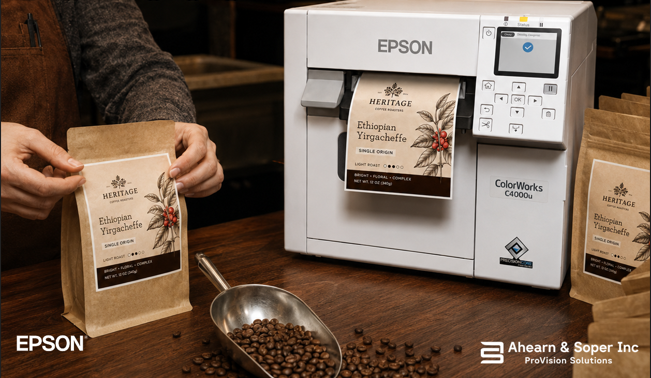
The C4000's compact design meant it lived right next to the bagging station, labels printed and applied in the same motion, no walking labels across the room from a separate print run days earlier.
Every coffee roaster has a drawer, a shelf, or a back-room box like this: half-used rolls of a label design for a coffee you don't sell anymore. A case of labels printed with the wrong best-by date format. Two thousand labels for a blend that got renamed after a single harvest. It's not clutter, its cash, sitting there unused, that you paid for and can't get back.
Pre-printed label suppliers work in volume because that's how their economics function. Ordering pre-printed labels typically requires meeting minimum order quantities that demand significant upfront investment. For a roaster with one flagship blend, that math can work. For a roaster running seasonal single-origins, limited micro-lots, and a handful of wholesale private-label accounts, it doesn't, every one of those becomes its own minimum order, its own storage line, its own risk of going obsolete.
• A harvest ends and next year's lot tastes different enough to need a new name.
• A wholesale partner rebrands. • An ingredient or allergen disclosure changes and the old labels legally can't be used anymore.
• A roast date format needs to change to meet a new retailer's requirement.
When label designs change or products change, pre-printed labels can become obsolete, direct waste that still cost real money to produce. None of that waste shows up as a line item called "waste." It shows up as shrinking margin you can't quite explain.
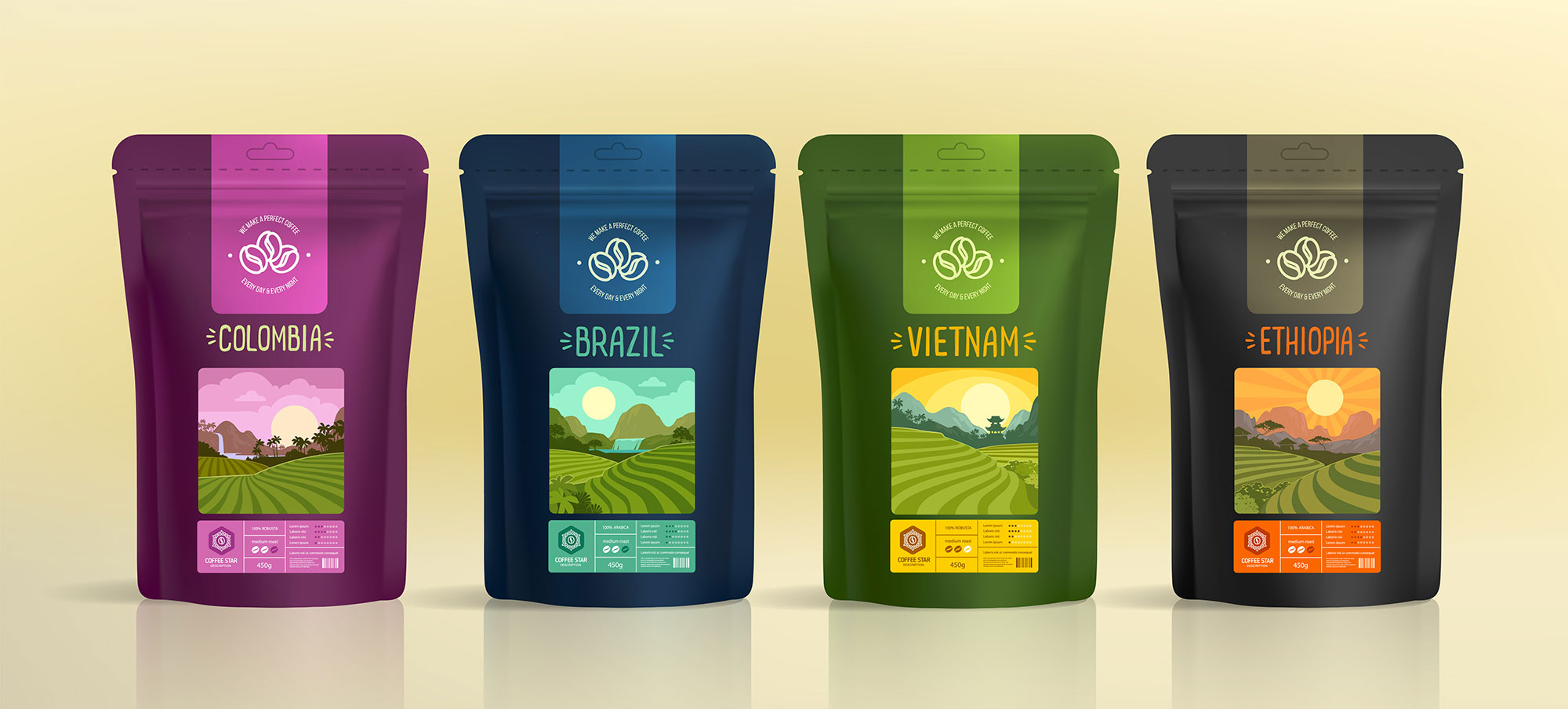
Specialty coffee thrives on variety; that's part of the appeal to your customers. But every new origin, process method, or roast profile is a new SKU, and under a pre-printed model, every SKU multiplies your label risk. On-demand label printing changes the underlying economics of managing multiple product variations: instead of holding inventory for every SKU variant, you manage a single thing, blank label stock.
Limited releases stop being a liability. A small brewery facing pre-printed minimums of 1,000 labels per design for runs as small as 200 bottles switched to an Epson ColorWorks printer and now prints exactly what a batch needs, a 300-unit run gets 300 labels, a 50-unit test batch gets 50. The same logic applies directly to a 40-bag micro-lot or a one-off collaboration roast.
Recipe and roast profile changes cost nothing to implement. When a formulation or ingredient disclosure changes, you simply update the label file and print, the old version doesn't become worthless inventory, because it never existed as physical stock in the first place.
Private label wholesale stops requiring a minimum order negotiation. Producing 100 units for a retail partner no longer requires ordering thousands of labels, you print exactly 100 and move to the next project.
Zero waste isn't only about what doesn't end up in a landfill, it's also about what never gets shipped in the first place. Pre-printed labels typically involve additional packaging and shipping from an outside supplier, and bulk production runs over long shipping distances can add to a business's carbon footprint; in-house printing reduces those environmental costs by eliminating that extra shipping and packaging. Producing labels on demand, in-house, also reduces the carbon footprint associated with transporting pre-printed stock from a supplier's facility to yours.
For the Epson ColorWorks C4000 specifically, the sustainability case extends to the hardware itself: the printer is RoHS compliant, built as a recyclable product, and part of Epson's SmartWay Transport Partner program. Paired with Epson's use of environmentally conscious inks and materials in the ColorWorks line, the result is a labeling process where the biggest sustainability win, not printing more than you need is baked into how the system works, not bolted on as a marketing claim.
For a roaster building a brand around sourcing transparency or environmental responsibility, that's not a side benefit. It's a story that holds up under scrutiny, because "we only print what we sell" is a claim you can stand behind.
Picture a roastery running four rotating single-origins, a house blend, a decaf, and two wholesale private-label accounts, eight active SKUs, each with its own label. Under a pre-printed model, that's eight separate purchase orders, eight minimum-quantity commitments, and eight ways for a batch to sit unsold while its labels age out.
With an Epson ColorWorks C4000 running from a shared library of label templates, it becomes one blank stock, eight files, and a print run sized to exactly what that week's roasting schedule calls for. On-demand printing eliminates the need to hold pre-printed inventory at all, reducing waste and allowing labels to be updated immediately whenever product information changes. Nothing sits in a drawer waiting to become obsolete, because nothing gets printed until it's needed.
Zero waste doesn't have to mean an overhaul of your whole operation. It starts with one question: how much of what you've printed this year never made it onto a bag? For most small roasters, that number is bigger than they'd guess, and it's the clearest sign that the labeling model, not the coffee, is what needs to change.
Ahearn & Soper Inc. works with businesses of every size, from small specialty producers to large manufacturing operations, to identify the right on-demand labeling solution for their needs, including how many SKUs you're really managing and what a switch to print-on-demand would look like for your current packaging line.
Ready to see how much label waste your roastery could eliminate? Get in touch with our team for a walkthrough of the ColorWorks C4000 and a straightforward look at your numbers.
Browse more practical insights connected to warehouse management, automation, labelling, mobility, and support.