This is the story of how The Coffee Shop stopped buying labels, and started printing exactly what they needed, when they needed it.
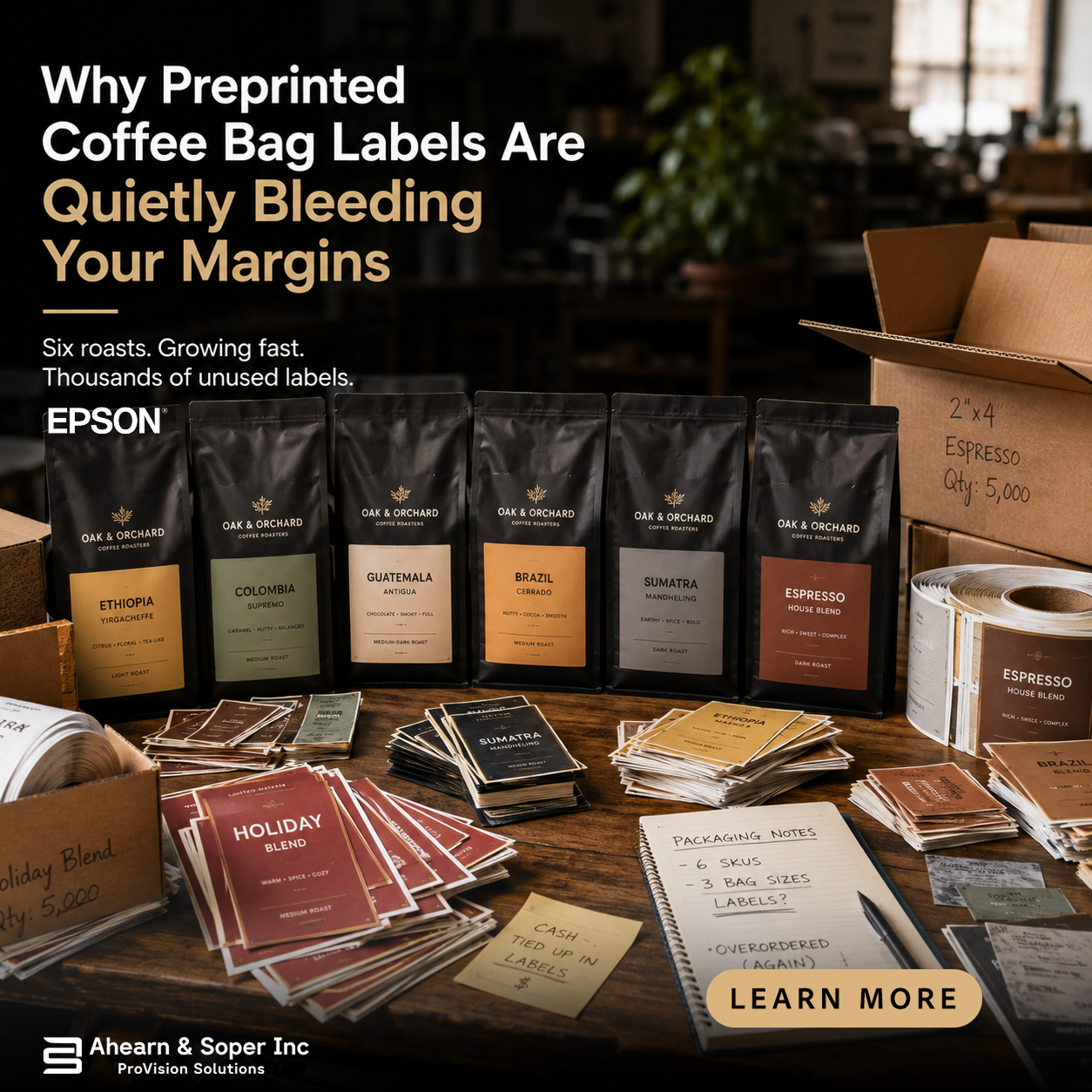
Ask most roasters what their labels cost them, and they'll quote you a per-unit price from their last purchase order. That number is real, but it's also the smallest part of the story. The actual cost of pre-printed labeling doesn't show up on the invoice, it shows up scattered across a dozen line items that never get labeled "labeling cost" at all: a shelf of obsolete stock, a rush reorder fee, a wholesale opportunity you quietly passed on. None of it looks like a labeling problem. All of it is one.
A pre-printed label quote looks clean: a per-thousand price, a lead time, a minimum order quantity. What it doesn't show is everything that price assumes about your business, that your product mix won't change, that your roast dates won't need updating after the fact, that you'll sell through the full order before anything about the label needs to change.
Ordering pre-printed labels typically requires meeting minimum order quantities that demand significant upfront investment, investment that only pays off if every one of those labels eventually gets used exactly as printed. For a roaster with a single, unchanging flagship blend, that assumption might hold. For nearly everyone else, rotating single-origins, seasonal releases, wholesale accounts with their own branding, it doesn't, and the gap between "labels purchased" and "labels used as intended" is where the real cost lives.
1. Obsolete inventory you already paid for. When label designs change or products change, preprinted labels can become obsolete, direct waste that still cost real money to produce. A renamed harvest, a rebranded wholesale account, an ingredient disclosure update: each one can turn a box of paid-for labels into shelf clutter overnight.
2. The roast date workaround. Most pre-printed labels can't carry a roast date, lot number, or best-by date as part of the original print run, that information has to be added after the fact, by hand or with a secondary printer. That's an extra labor step, on every batch, forever, and every manual entry is a chance for an error that a regulator or a customer will eventually notice.
3. Lead time tax on your calendar. A reorder from a pre-printed supplier can take weeks. That's fine when nothing is urgent. It's a real cost the moment a seasonal blend, a collaboration bag, or a wholesale accounts rebrand needs to move faster than your print vendor's queue allows, and "we'll wait for the reorder" quietly becomes "we'll skip this opportunity."
4. The opportunities you don't take. This is the least visible cost and often the largest. A minimum order quantity doesn't just add expense to a limited release, it makes the decision for you before you've evaluated whether the opportunity was worth pursuing. A 60-bag exclusive, a farmers market one-off, a distributor's short-notice request: under a pre-printed model, the label logistics reject these before the business case even gets considered.
5. Storage and shipping you don't think of as a label cost. Pre-printed labels typically involve additional packaging and shipping from an outside supplier, adding to both direct cost and a business's carbon footprint. Add the shelf or closet space every box of unused stock occupies, and the "cheap" bulk price starts looking less cheap the longer it sits unsold.
None of these costs appear on a P&L line called "wasted labels." They show up as slightly lower gross margin on wholesale orders, slightly higher labor cost per batch, and a slightly smaller catalog of releases than the business could otherwise support, each one small enough to explain away individually, and easy to miss entirely if no one's ever added them up together.
That's precisely why the pre-printed model persists as long as it does in small coffee operations: it's not that roasters don't notice rising costs, it's that those costs never get attributed back to the label decision that's driving them.
The alternative isn't complicated: print exactly what you need, when you need it, directly from a digital file, with the roast date and lot number built into the same print run instead of added afterward. Instead of holding pre-printed inventory for every SKU variant, an on-demand system manages a single thing, blank label stock, which means a formulation change, a rebrand, or a one boff release costs you a file update, not a scrapped print run.
That shift doesn't just recover the direct cost of unused labels. It removes the decision-suppressing effect of minimum order quantities, the opportunities that never got evaluated because the label math made the answer "no" before anyone asked the question.
The fastest way to see this in your own numbers isn't to ask, "what do labels cost per thousand." It's to ask three questions instead: How many labels from your last few orders never made it onto a bag? How many times in the past year did a roast date or a compliance detail must be corrected after printing? And how many small, interesting opportunities, a limited release, a one-off wholesale request, did you pass on because the label order didn't make sense for the volume?
For most small roasters, the honest answers to those three questions add up to a bigger number than the per-unit label price ever suggested.
Ahearn & Soper Inc has provided barcode and identification hardware, software, supplies, and services since 1975, and we work with roasters to look at exactly this kind of hidden cost, not just to quote a printer, but to help you see where your current labeling model is actually working against your margins.
Curious what your own label math adds up to? Talk to our team for a straightforward look at what pre-printed labeling might be costing your roastery beyond the invoice.
Browse more practical insights connected to warehouse management, automation, labelling, mobility, and support.