Excess label inventory ties up cash, reduces flexibility, and prevents small businesses from investing in growth opportunities.
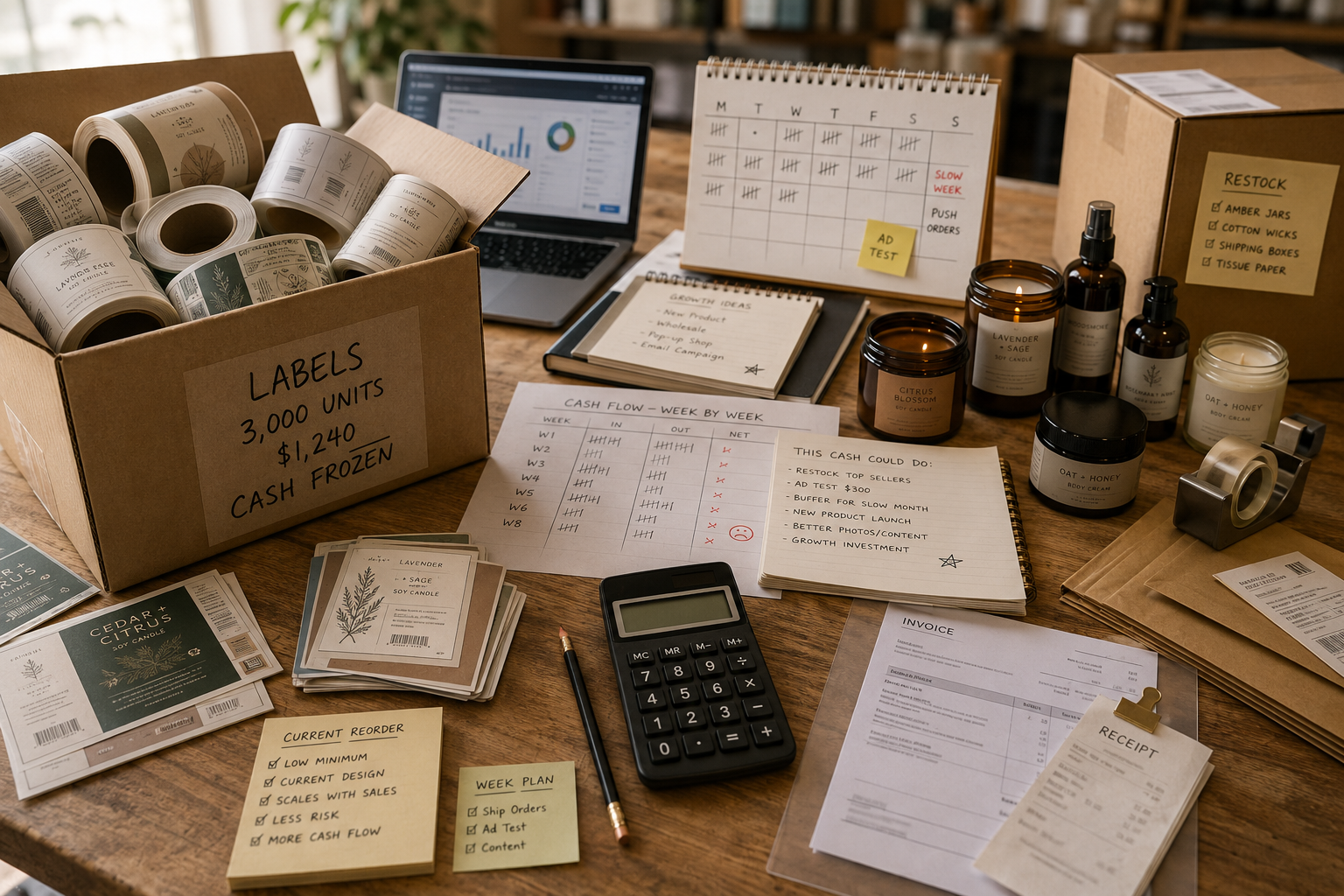
A box of unused labels isn't a supply. It's a loan you made to your past self, at a terrible interest rate, with no way to call it back.
That's not a metaphor for drama. It's literally what over-ordering does. And for a small brand, where cash flow is the business, it's one of the most underrated mistakes you can make.
Big companies survive on profit. Small brands survive on cash flow, the actual money moving in and out, week to week. You can be profitable on paper and still go under if your cash is stuck in the wrong place at the wrong time.
Labels are a classic wrong place. When you drop $1,400 on a giant run, that's not "an asset." It's $1,400 you no longer have to cover a slow month, restock a hot product, or jump on an opportunity. The money didn't disappear; it just got immobilized in a form you can only use one slow label at a time.
Economists call it opportunity cost; founders call it "the thing I couldn't afford because my money was in a box." That $1,400 could have been:
• Inventory that sells in two weeks.
• An ad test that finds your next channel.
• A buffer that lets you sleep through a slow stretch.
Instead, it's labels, slowly being consumed, earning nothing, sometimes going obsolete before they're used. Of every place to park your scarce cash, a stockpile of labels is one of the worst, because it's both illiquid and perishable.
Here's the cost that never makes it into a spreadsheet, and it might be the biggest one.
Over-ordering breeds a low-grade dread. Every time you see the box, you're reminded of a decision you can't undo. And after one expensive lesson, you get cautious in exactly the wrong way, you stop testing new designs, stop launching variants, stop experimenting, because experiments now feel like more boxes waiting to happen. The financial loss is finite. The risk-aversion it installs can quietly cap your growth for years.
The fix is to stop treating labels as a big upfront bet and start treating them as a variable cost — small, frequent, scaling with sales. With on-demand printing, you spend a little at a time and reorder as product moves. Your cash stays liquid, your labels stay current, and the box of dread never gets built.
Slightly higher per label? Yes. But you're buying back your cash flow, your flexibility, and your willingness to keep trying things. For a small brand, that's not a cost. That's the whole point.
Keep your cash where it can work. [Order on demand] and turn labels from a lump-sum gamble into a small, flexible cost that scales with your sales.
Browse more practical insights connected to warehouse management, automation, labelling, mobility, and support.