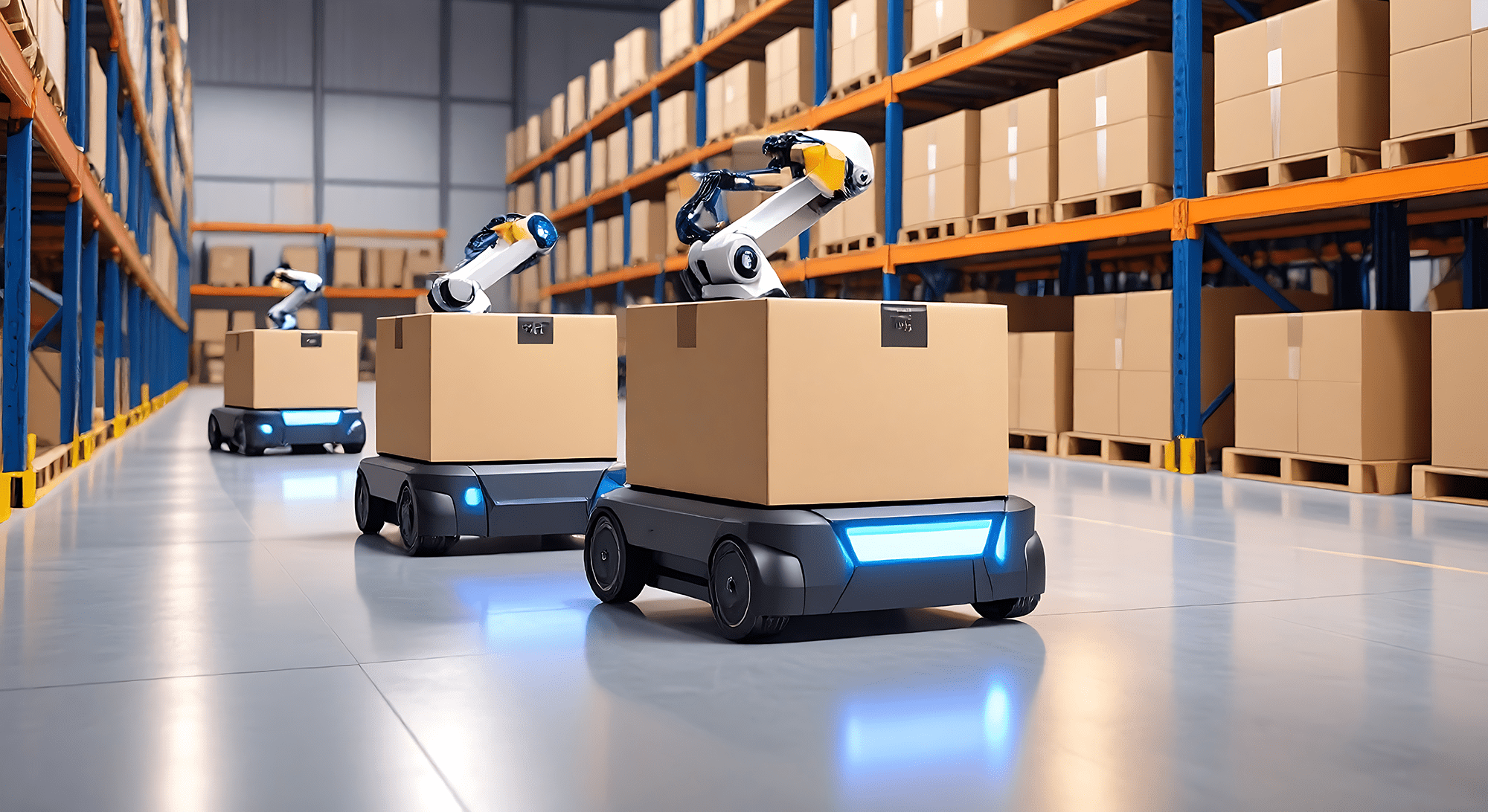
Explore the reality behind 90% warehouse tech adoption and its impact on modern operations.
Ahearn & Soper Inc.
If you've spent any time reading warehouse and supply chain trend pieces this year, you've probably seen some version of the stat "nine in ten warehouses are investing in new technology." It gets quoted a lot, usually stripped of context, usually implying that automation is already everywhere except your building.
Here's the thing: that 90% figure is real. It comes from Zebra Technologies' Warehousing Vision Study, one of the most-cited pieces of primary research in this industry. But it's also not one number, it's at least three different findings, from different years, measuring different things. Conflating them is how you end up either panicking that you're behind or dismissing the whole trend as marketing noise. Neither reaction is useful. So, here's what each "90%" measures, and what it means for a warehouse that hasn't automated much of anything yet.
1. "Nearly 90% agree they must modernize to compete" (2022 study) — an attitude, not an action. Zebra's 2022 Warehousing Vision Study found that almost nine in ten warehouse operators agreed they needed to implement new technology to stay competitive in the on-demand economy. That's a belief statement. It tells you sentiment has shifted, it doesn't tell you what anyone installed.
2. Autonomous mobile robots headed toward 90% adoption (2022 study, five-year forecast) — a specific technology projection. The same study found that 27% of warehouse operators had already deployed some form of autonomous mobile robot (AMR) at the time, with that number expected to climb to roughly 90% within five years. That forecast puts the target year at around 2027, which means we're currently in the window where that prediction is supposed to be resolving. Worth watching: if your DC hasn't touched AMRs yet, you're not late by the study's own timeline, but the runway is getting shorter.
3. Nine in ten planning to invest in supply chain visibility (Zebra's more recent Warehouse Vision Study) — an investment plan, not a completed rollout. Zebra's latest research, cited alongside its 2025 ProMat and Automate showcase announcements, puts a related but distinct number on the board: over the next five years, nine in ten warehouse decision-makers expect to invest in technology that increases supply chain visibility. That's forward-looking capital intent, not a report card on what's already live on the floor.
Notice the pattern: none of these three is "90% of warehouses have already automated." They're an attitude, a five-year forecast for one specific technology category, and a five-year investment intention for a different category. All three are legitimate and worth paying attention to, but the honest read is "the industry has decided this is the direction," not "everyone else already got there."
The more interesting number, if you're deciding what to do this year rather than what to believe about the industry, is the pressure gap. Zebra's most recent Warehousing Vision Study found 70% of warehouse decision-makers are under high pressure to modernize right now, and 63% plan to accelerate their modernization timelines. That's a meaningfully large share of the industry saying the pressure isn't hypothetical anymore, it's this year's problem, not a five-year-out concern.
Some of what's driving that pressure isn't really about technology at all, it's about physical growth outpacing current operating models. Interact Analysis projects global warehouse floor space will grow roughly 27%, from 33 billion square feet in 2023 to 42 billion by 2030, with warehouse labor spend growing at a compound annual rate of around 7% through the same period. More space and more labor cost, without a plan to make each square foot and each labor hour more productive, is exactly the condition that pushes "modernize eventually" into "modernize this budget cycle."
The frontline workforce is telling a consistent story from the other side of the pressure. In that same recent study, 85% of warehouse associates said that if their employer doesn't invest in technology, the business won't meet its objectives and separately, in Zebra's 2022 research, roughly eight in ten associates reported that positive workplace changes were already happening amid the labor shortage, driven partly by better technology adoption. Workers aren't the obstacle to modernization in this data. If anything, they're ahead of some of the decision-makers on wanting in 74% of associates in the recent study said they're concerned about spending too much time on tasks that could already be automated.
Strip away the headline stat and the "90%" conversation is about four distinct categories of investment, each moving at its own pace:
Most warehouses that look "behind" on the 90% number have made progress in one or two of these categories, usually frontline devices, while assuming the whole conversation is about robotics, which is the category with the highest cost and longest timeline. That's a framing problem, not necessarily a real gap.
You don't need to solve all four categories at once, and the data doesn't suggest anyone does. A reasonable sequence for a warehouse that's early in this process:
If you want help figuring out where your operation actually sits against this, which of the four categories is worth prioritizing first given your volume, your current device fleet, and your budget cycle, that's a conversation Ahearn & Soper has with warehouse and DC teams regularly, across mobile computers, barcode scanners, RFID, and the software that ties it together. No pressure to buy into the whole roadmap at once; most of the operations we work with are picking one category to get right this year, not chasing all ninety percent of it in one budget.
Browse more practical insights connected to warehouse management, automation, labelling, mobility, and support.