Twelve months, three printers, one consistent theme: print what you need, when you need it.
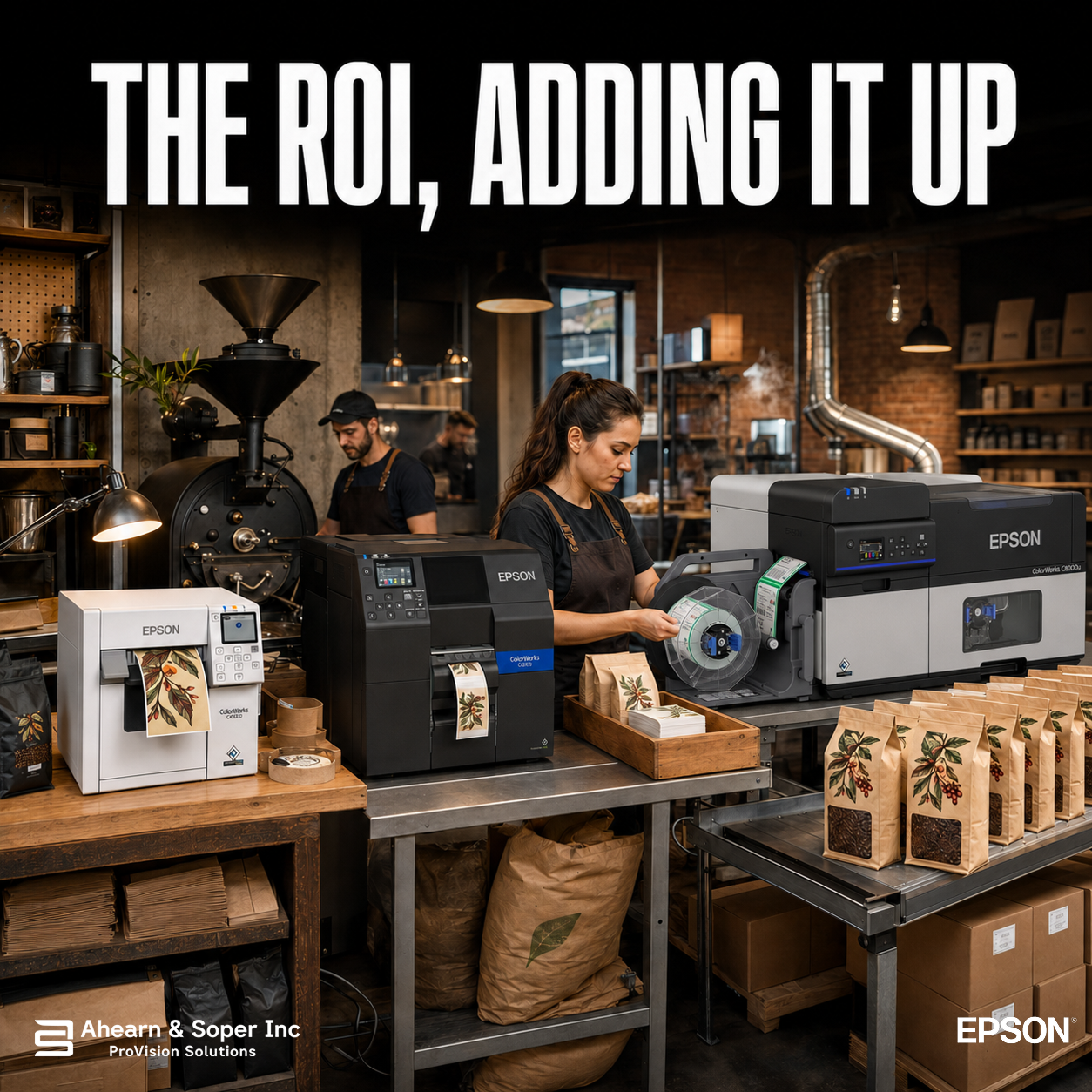
Twelve months ago, The Coffee Shop was running labels the way most small roasters do: pre-printed stock, minimum order quantities, and a drawer of half-used rolls for products that didn't survive their first harvest. Today, the same business runs a CW-C8000 in a packing room built around continuous, on-demand production, with a C4000 and a C6000 still earning their keep elsewhere in the operation.
Three printers, one year, and underneath all of it, the same idea repeated at three different scales: print what you need, when you need it. It's worth stepping back and adding up what that idea was worth.
The starting problem, covered in the first post of this series, wasn't volume, it was the minimum order quantity sitting underneath every label decision. A pre-printed model meant every new singleorigin, every seasonal blend, every wholesale request came with an implicit tax: order thousands of labels you might not need, or don't do it at all.
The C4000 removed that floor. Over its first several months in the packing room, three things changed that a spreadsheet wouldn't have predicted in advance:
• Waste that used to be invisible became visible, then avoidable. Labels for a renamed harvest, a rebranded wholesale account, a roast-date format change, the kind of obsolete inventory that pre-printed labeling makes an unavoidable cost of doing business, simply stopped accumulating.
• Limited releases stopped being a math problem. A 60-bag exclusive lot went from "not worth the print run" to "print exactly 60 and move on," the shift covered in this series' business case for saying yes.
• Variable data turned one printer into six product lines, without six separate label files, six separate vendor relationships, or six separate places for a compliance error to hide.
None of this shows up as a single dramatic number. It shows up as a roastery that stopped saying no to opportunities the old label math couldn't justify, which is, in the end, the actual return on a C4000: not what it saved on labels already being printed, but what it made possible that wasn't happening before.
By the middle of the year, two things had grown past what the C4000 was built for: a wholesale account placing large, regular orders, and a subscription list that had moved from a side project to a real revenue line. Both showed up in this series as distinct posts, and both point to the same underlying shift, volume and variability growing together, not separately.
The move to a C6000 paid off in ways that were more countable than the C4000 phase:
• Peel-and-present labor time, on a C6000P, turned manual label application on wholesale orders from a standing packing-day task into something closer to background work, real
minutes saved, multiplied by every reorder from every account.
• Subscription fulfillment stopped requiring a second machine. What used to mean a color label printer plus a separate thermal printer for shipping data consolidated into a single pass, removing both a cost and a source of mismatched-label errors on individual boxes.
• The larger ink cartridges and 5-inch-per-second print speed meant fewer interruptions during the packing day, a smaller marginal cost difference than the hardware itself, but a real reduction in downtime and maintenance overhead compared to the C4000 at growing volume.
This is the phase where the ROI conversation stopped being purely about avoided waste and started being about labor hours recovered, hours that went back into roasting, packing, and running a growing wholesale and subscription business instead of babysitting a label queue.
The grocery chain account changed the calculation one more time. Sixty stores, four SKUs, and a restocking commitment that didn't leave room for the printer to become the constraint, that’s the scenario this series covered as the inflection point that justified skipping straight past the mid-tier C6500 to the C8000.
The return here is the most direct of the three phases, because the alternative was concrete: without the throughput to reliably hit a 60-store restock schedule, the account itself was at risk. The C8000's PrecisionCore Heat-Free technology delivers up to 12 inches per second at consistent image quality, and its high-yield ink system and permanent printhead reduce the maintenance interruptions that would have been unacceptable on an account where a stockout could mean losing shelf space permanently.
Put simply: the C4000 and C6000 phases were about efficiency and avoided cost. The C8000 phase was about keeping a revenue commitment the business had already made and here, the ROI isn't primarily "cheaper labels." It's "the labeling system didn't become the reason the grocery account failed."
The Coffee Shop's numbers throughout this series have been illustrative, built to make a real decision-making pattern concrete, not pulled from an audited P&L. But the pattern holds up against real, published outcomes from other Ahearn & Soper customers running the same equipment:
One craft beverage producer running a C4000 across 15 different products eliminated roughly $12,000 a year in pre-printed label inventory and obsolescence costs, the same category of savings The Coffee Shop's C4000 phase was built around, just measured on a real account. Businesses moving into the C6000 tier have reported cutting new-product time-to-market from weeks to days, which lines up directly with what changed for The Coffee Shop's subscription and wholesale timelines. And at the C8000 tier, the reported outcomes shift from cost savings toward the same reliability-at-scale story this series talked about the grocery chain account: eliminating the waste associated with incorrect pre-printed labels while keeping pace with compliance-heavy, high volume production.
If there's a single figure that captures the whole year, it isn't a dollar amount on any one printer. It's this: at no point across three printers, three volume tiers, and one significant new retail account did The Coffee Shop have to say no to an opportunity because the labeling system couldn't keep up. Every other number in this series, labor hours, waste eliminated, time-to-market, throughput is just a way of measuring that one outcome from a different angle.
That's the actual return on an on-demand labeling strategy: not that it's cheaper at any single point in time, though it usually is, but that it scales with the business instead of constraining it, from a first C4000 on a countertop to a C8000 running a production floor.
Ahearn & Soper Inc has supported businesses through exactly this kind of growth, from first-time buyers evaluating whether on-demand labeling makes sense at all, to established operations sizing their next upgrade with production analysis, media recommendations, and ongoing support at every stage.
Wherever your business is on this same journey — first printer, next upgrade, or an account that's outgrown your current setup, talk to our team. We'll help you figure out what the real numbers look like for where you are, not just where The Coffee Shop ended up.
Browse more practical insights connected to warehouse management, automation, labelling, mobility, and support.