Bulk label orders can hide costly risks, while short-run digital printing preserves cash, flexibility, and inventory efficiency.
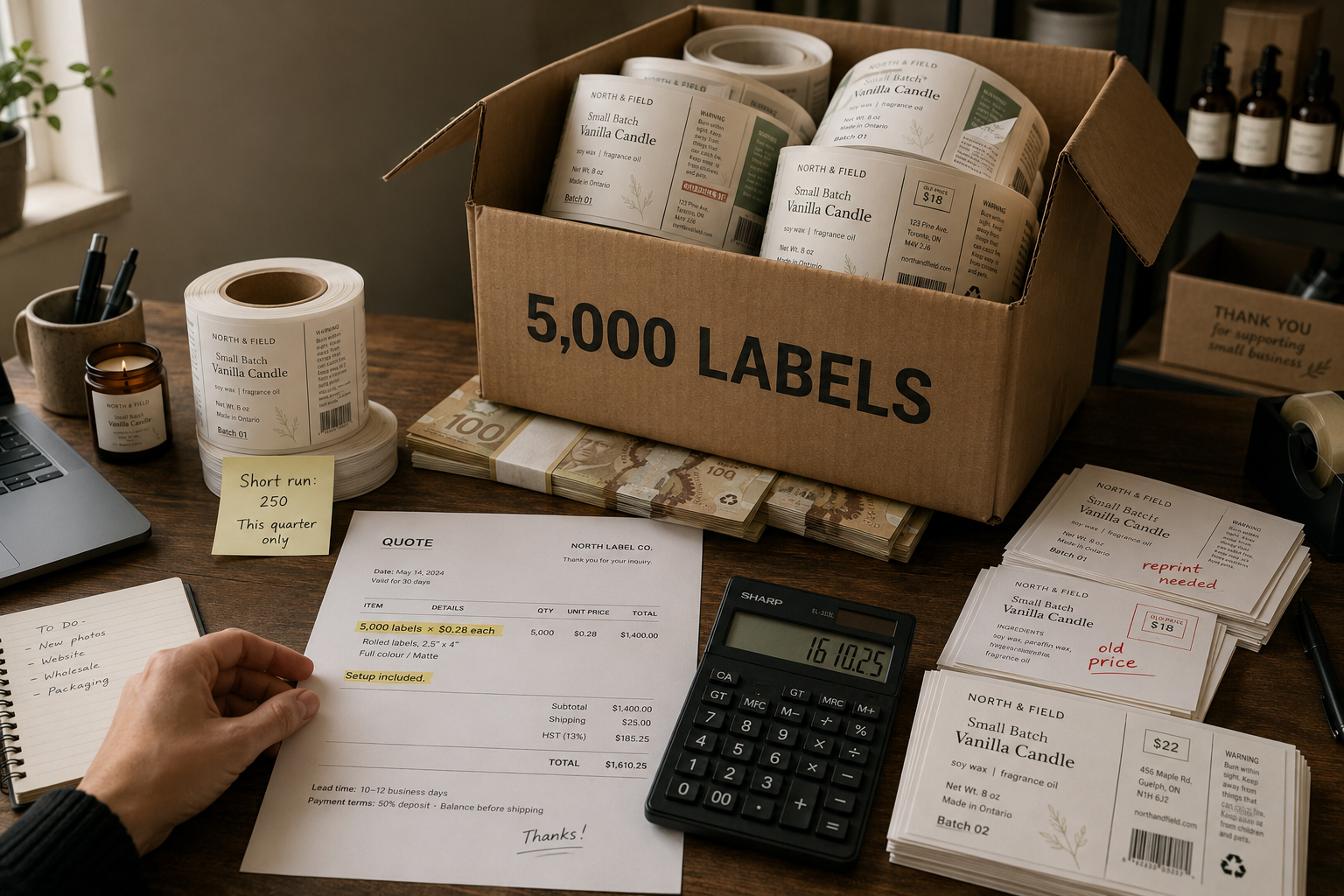
The quote says twenty-eight cents a label. That's the number you'll remember. It's also the only honest number on the page, and it's nowhere near what those labels actually cost you.
Because the price of a label isn't the price of a label. It's the price of everything that happens after you've ordered 5,000 of them and your business turns out to be a moving target, the way every new business is.
Here's the trap, and it's a good one. At 500 units, your labels cost a fortune per piece. At 5,000, the per-unit price collapses. Same setup fee, spread thinner. Your spreadsheet lights up. You feel like you've outsmarted the system.
You've optimized for the one cost that's visible and ignored four that aren't.
The moment you pay for 5,000 labels, that money stops working. It can't buy inventory, fund an ad test, or cover a slow month. It's just sitting in a box, "saving" you money it can no longer earn. For a brand counting every dollar, idle cash is one of the most expensive things you can own.
You will change something in your first year, your recipe, your price, your address, a regulated ingredient line, your logo. The bigger your run, the more labels that change instantly invalidates. A 500-unit mistake stings. A 5,000-unit mistake reshapes your month.
Five thousand labels take up space, and space in a small operation is never free. More quietly, they take up attention, every time you see the box, you're reminded of a decision you can't undo.
Here's the cruelest one. If your first big run has any flaw and rushed first runs usually do — you don't get to use it. You reprint. Now you've paid for the job twice, and your "bulk discount" is a rounding error against the cost of doing it over.
Before any large order, ask one question: How long will it realistically take me to use these?
Not your optimistic number. Your honest one. If the answer is "more than a few months," you're not buying labels. You're pre-paying for a version of your product that may not exist by the time your each the bottom of the box.
Short-run, digital printing flips the whole equation. No plates, no setup fee to amortize, no minimum forcing your hand. The per-label price is a little higher, and that's the entire point. You're trading a slightly higher unit cost for the freedom to never freeze your cash, never sit on obsolete stock, and never pay for a run twice.
The cheapest label in the world is the one you actually use. Everything else is just an expensive box.
Want a quote with no minimums and no surprisesetup fees? [Get a real price on a short run] and only buy what you'll use thisquarter
Browse more practical insights connected to warehouse management, automation, labelling, mobility, and support.