High minimum order quantities increase financial risk, reduce flexibility, and prevent businesses from scaling efficiently with changing demand.
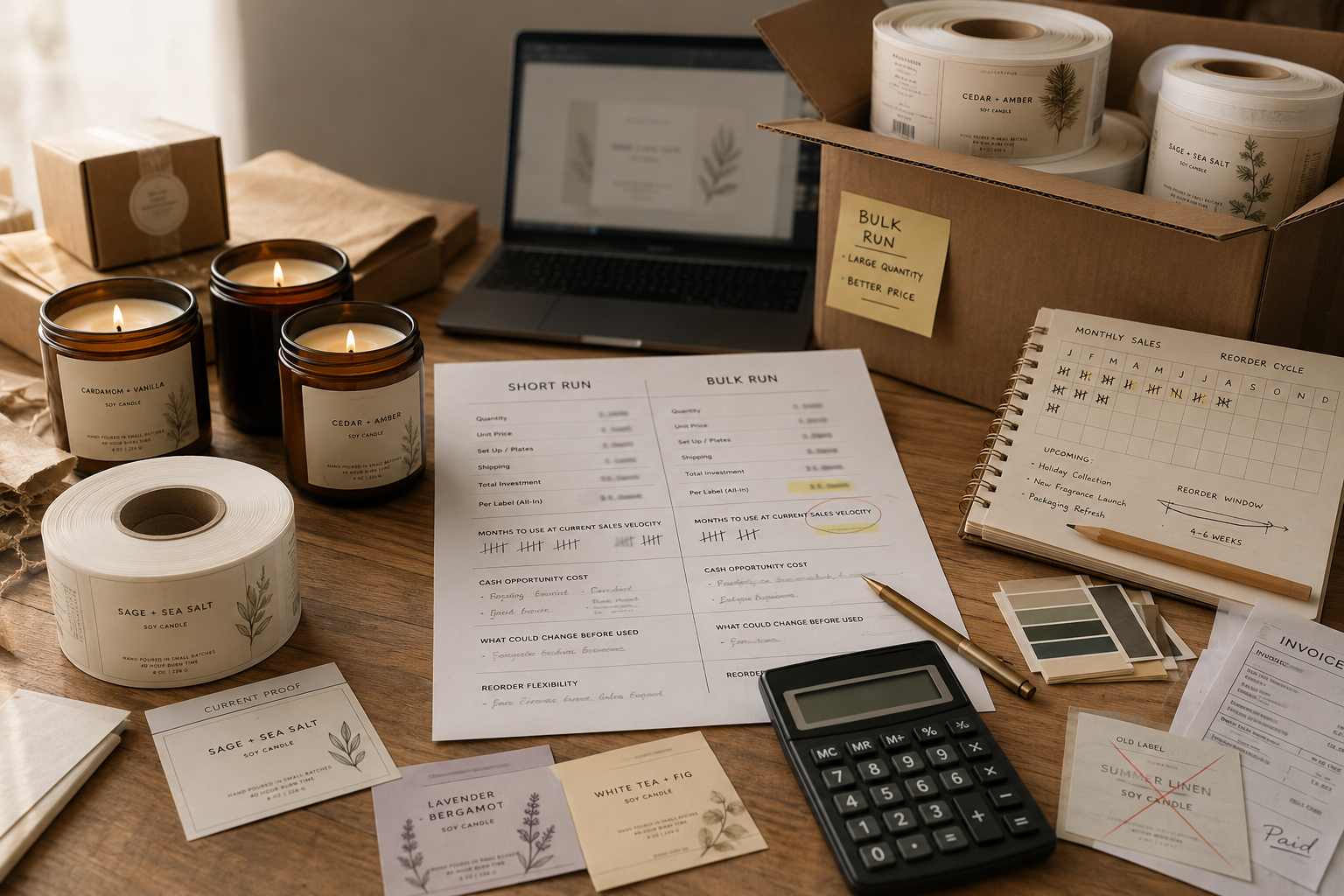
The MOQ is the most innocent-looking number in the printing industry. Three or four digits, tucked into a quote, easy to skim past. It's also quietly ended more small brands than bad products ever have.
Not with a bang. With a slow squeeze.
A minimum order quantity is the smallest run a printer will accept. It exists for a real reason: traditional presses have setup costs (plates, dies, calibration) that only make economic sense across large runs. Below the minimum, the printer loses money. So, they set a floor.
The reason is legitimate. The consequences for small brands are brutal.
It forces a bet you can't afford to lose. A high minimum means your first order is also your biggest financial risk, placed before you've sold a thing.
It freezes your cash. Money that should fund stock, marketing, or a slow month is locked in a box of labels instead.
It kills experimentation. Want to test three designs? Launch a seasonal variant? Try a new scent? Every idea now costs a full minimum run, so you stop having ideas. The MOQ doesn't just limit your orders, it limits your imagination.
It manufactures waste. Recipe changes, rebrands, slow sales, and a chunk of that minimum order ends up in the recycling. (See: every founder's garage.)
The MOQ was a rule for an era of plate-based printing. Digital, on-demand printing has no plates and no setup to recover, which means it has no economic reason to impose a high minimum. The floor that's been squeezing small brands is a leftover from a technology you don't have to use anymore.
1. Choose an on-demand, short-run printer with low or no minimums. This is the whole game. Match the print model to your stage.
2. Order what you'll use in the next month or two, not the next year. Let near-term reality, not a price chart, set the quantity.
3. Test before you commit. Use small runs to try designs, finishes, and variants. The MOQ used to make experiments expensive; now they're cheap.
4. Reorder as you sell. Reprint in small batches funded by actual revenue, scaling up only when sell-through proves it's safe.
5. Save the big run for a sure thing. Once a product is genuinely validated and moving fast, a large order can make sense. By then you'll be ordering from strength, not from optimism.
The MOQ was never a law of nature. It was a constraint of old equipment, and you don't have to inherit it. Step around it, and you get to run your brand the way it should be run small, fast, and free to change its mind.
Done being squeezed by minimums? [Get a no-minimum quote] and order exactly what your brand needs, nothing more.
Browse more practical insights connected to warehouse management, automation, labelling, mobility, and support.