The C8000's heavy-duty construction is what makes 24/7 operation realistic.
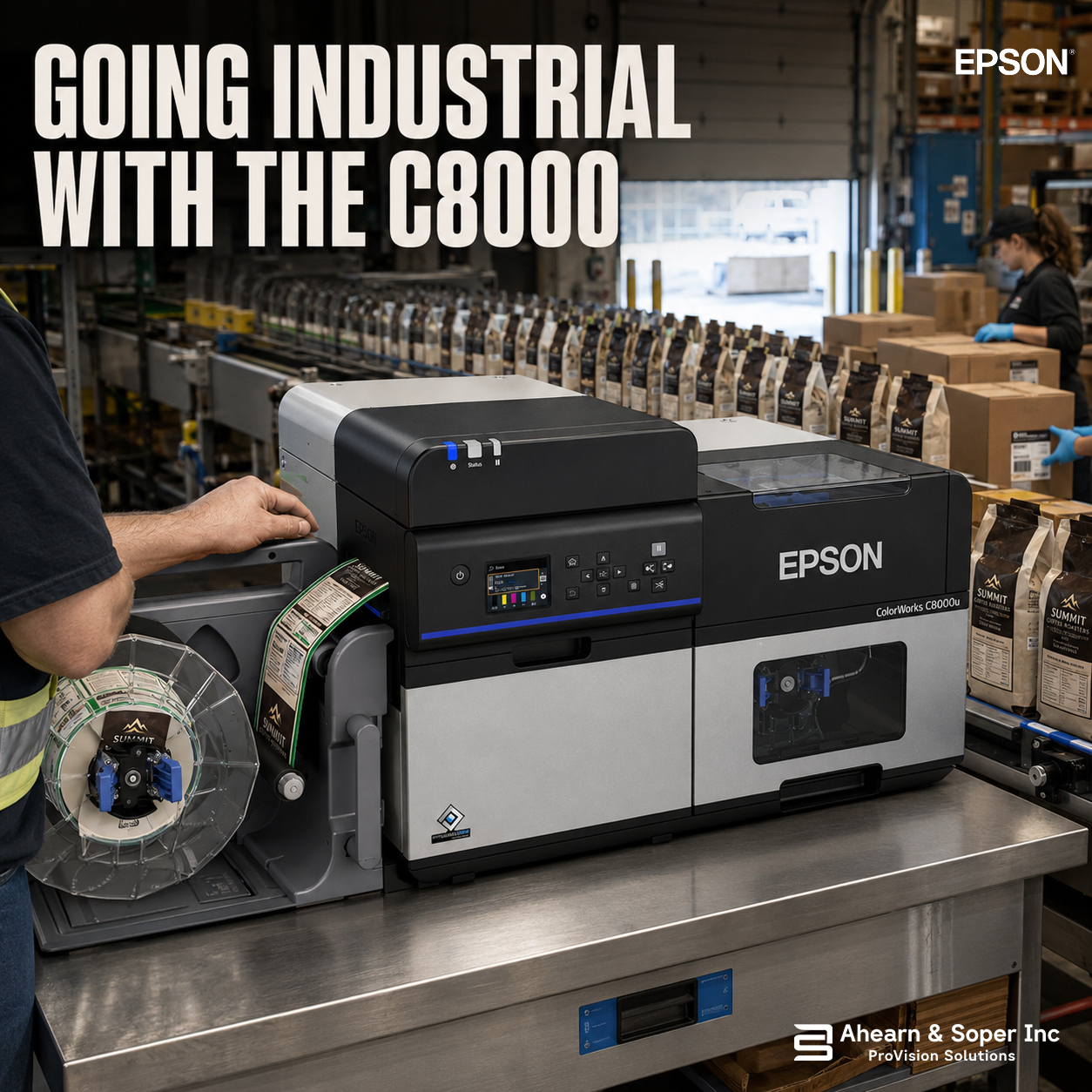
Six weeks after the grocery chain account launched, The Coffee Shop's packing room looks different. The C6000 that used to run in short bursts between roasting and packing has been replaced by a CW-C8000 and the difference isn't really about the printer sitting in a new spot. It's about what a production day looks like now that labeling isn't something squeezed in around the schedule, but something the schedule is built around.
Here's what that day looks like.
The packing lead doesn't spend the first twenty minutes of the shift waiting on a printer to warm up or checking ink levels one cartridge at a time. The C8000 runs on a high-yield 1.9-liter total ink capacity, loaded as large-format ink packs rather than small individual cartridges, the kind of consumable that gets checked once at the start of the week, not once an hour. The PrecisionCore permanent printhead is built for fewer interventions and low maintenance costs, so the morning routine is closer to confirming the queue than performing maintenance.
The day's print queue is already loaded: four grocery-chain SKUs, this week's rotating single-origin, and two wholesale private-label runs, all pulled from the same variable-data templates the roastery built back when a C4000 was still running the whole operation. Nothing about the underlying label system changed with the printer upgrade, only how fast and how continuously it runs.
The C8000 is engineered for mid-to-high-volume batch runs, printing at speeds up to 12 inches per second, a genuine step up in throughput from the C6000 this roastery ran for the past two years, and the difference shows immediately. What used to be a visible bottleneck between roasting finishing and boxes going out the door is no longer where the day's pace gets set. The grocery chain's four SKUs, sized for their restock schedule, run through as one continuous batch rather than a queue the team must babysit.
The optional rewinder accessory keeps high-volume runs moving without a person standing at the machine collecting finished labels, freeing that team member to work the packing line instead of the printer.
The concern going into an industrial-scale printer was whether speed would cost quality, whether labels at 12 inches per second would look noticeably different from the deliberate, lower-volume runs on the old C6000. They don't: the same PrecisionCore Heat-Free technology that drives the speed also delivers exceptional image quality and sharp precision at those speeds, and the durable UltraChrome DL pigment inks resist smudging, smearing, and fading regardless of run size. A grocery buyer evaluating shelf presence across 60 stores sees the same label quality on unit one and unit ten thousand.
By early afternoon, the grocery restock batch is done and the queue shifts to the rotating singleorigin and the two wholesale private-label jobs, smaller runs, different templates, same printer. This is where the earlier variable-data groundwork pays off again at a new scale: switching from a 4,000-unit grocery batch to a 200-unit wholesale run doesn't mean reconfiguring hardware, just loading a different template pulling from the same underlying product data.
Remote management and cloud printing capabilities let the team queue and monitor jobs without standing over the printer for every changeover, a meaningful shift from the early days of the C4000, when someone effectively owned "watching the printer" as part of their job.
The more telling part of the day is what no longer occurs. Nobody is placing an emergency call about a depleted pre-printed label inventory. Nobody is manually re-typing a lot number onto a template for the fourth SKU of the day. Nobody is choosing between running the grocery chain's order on time and getting the wholesale account's smaller order out the same week, the printer has the throughput to do both without either one waiting on the other.
Running on PrecisionCore Heat-Free technology also means the C8000 draws meaningfully less power during printing than the older C7500 generation it replaces, a detail that matters less for the packing line's day and more for a roastery that's started paying attention to what a printer running most of a shift, most days, actually costs to operate.
It would be easy to hear "industrial label printer" and picture something built for a factory floor The Coffee Shop's packing room doesn't resemble. That's not really what the C8000 changes. The C4000 and C6000 that carried this roastery through its earlier growth were built for controlled, office-like settings, the C8000's heavy-duty construction is what makes 24/7 operation realistic, but the workflow around it, the templates, the compliance-ready media, the variable data pulling roast dates and lot numbers, is the same system this series has followed from the beginning.
What changed is capacity to match a commitment the business made to a retail partner, not a wholesale reinvention of how labeling works. The C8000 didn't ask The Coffee Shop to become a different kind of company. It let the same company keep a promise to a much bigger one.
Ahearn & Soper Inc provides installation, integration, and ongoing training to help businesses get the most out of a high-volume ColorWorks system, support that matters most in exactly this transition, when a printer stops being a background tool and becomes core production infrastructure.
Curious what a day running an in-house C8000 production line looks like for your operation? Talk to our team about what high-volume, on-demand labeling would mean for your packing floor.
Browse more practical insights connected to warehouse management, automation, labelling, mobility, and support.